
What happens when two countries take nearly the same three ingredients and turn them into two very different desserts?
Well, I decided to find out!
Not long ago, I made Dutch Boterkoek, a rich, buttery dessert from the Netherlands. It was good, especially warm from the oven, but once it cooled, I wasn't quite as impressed.
Then I stumbled across Scottish Shortbread.
Butter. Sugar. Flour.
Wait a minute! Haven't I made something remarkably similar before?
Apparently, the Scots and the Dutch both know a thing or two about turning a few pantry staples into something sweet. But I was curious whether Scotland's version would turn out any differently.
And since I don't believe we've visited Scotland yet in my From the Kitchen series, this seemed like the perfect opportunity!
So, I pulled out my mixing bowl, softened some butter, and decided to put these two European treats to the test.
As it turns out, Scotland had a little surprise waiting for me!
A Little Twist on Traditional Shortbread
One thing I appreciate about Scottish Shortbread is its simplicity. Traditional recipes generally require just three ingredients: butter, sugar, and flour.
No eggs. No baking powder. No complicated techniques.
And no need to drag out the electric mixer!
The original recipe called for two cups of all-purpose flour. Instead, I used 1⅔ cups flour and ⅓ cup cornstarch.
Cornstarch helps produce a more tender, delicate texture because it doesn't contain the gluten-forming proteins found in wheat flour.
I also added a splash of vanilla extract.
I know, I know. That technically takes us beyond the traditional three ingredients, but I thought a little vanilla would complement all that buttery goodness.
And I'm glad I added it!
Here's another thing I loved about this recipe: I didn't bother with any special mixing techniques.
I simply dumped all five ingredients into one bowl and mixed everything together by hand!
No creaming the butter and sugar first. No separate bowls. No fuss.
Then I pressed the dough into my parchment-lined iron skillet, scored it into wedges, pricked the surface with a fork, and popped it into the oven.
It really doesn't get much easier than that!
The First Taste Test
Naturally, I couldn't resist sampling a piece while it was still warm.
My first impression?
Very good!
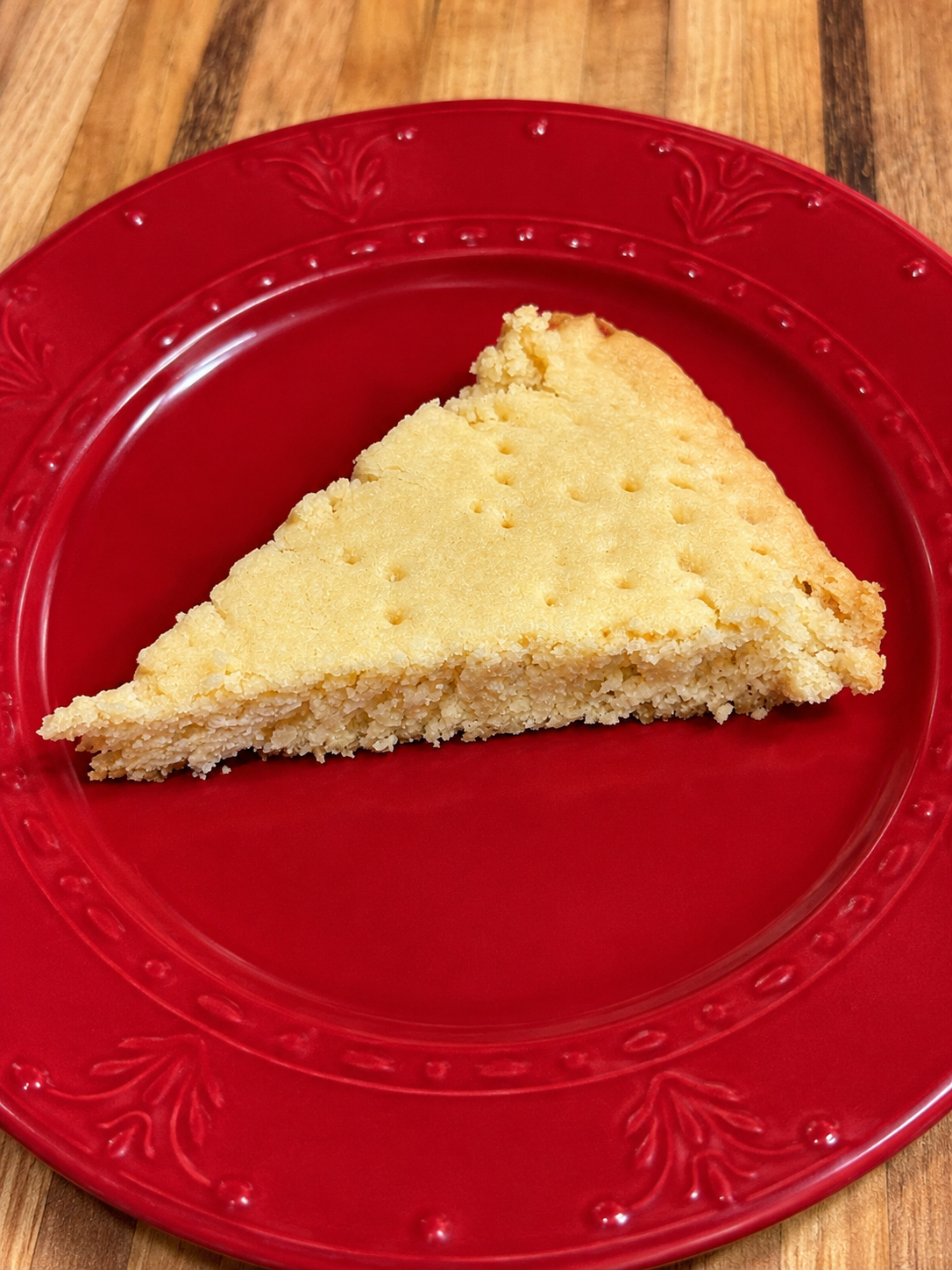
The flavor was buttery and lightly sweet, with just a hint of vanilla.
But what really caught my attention was the texture.
This shortbread was noticeably lighter and less dense than the Dutch Boterkoek I'd made previously.
It reminded me much more of a cookie than a cake or brownie.
And I suspect the cornstarch had quite a bit to do with that.
Still, I wasn't ready to declare a winner just yet.
After all, I'd enjoyed the Boterkoek warm from the oven, too.
The real test would come after the Scottish Shortbread had cooled completely.
Scotland vs. the Netherlands: Which Dessert Won?
Here's where things got interesting!
Both desserts have remarkably similar ingredients. And when you're working primarily with butter, sugar, and flour, there's only so much difference you can expect in flavor.
But texture? That's another story entirely!
The Dutch Boterkoek was dense and rich, almost like a cross between a cake and a brownie.
I enjoyed it warm, but by the following day, it had become drier and more crumbly than I preferred.
My final rating for the Boterkoek was 3½ out of 5 stars.
The Scottish Shortbread, on the other hand, had a lighter, more delicate texture.
It was tender and crumbly, but in a way that reminded me of a traditional butter cookie.
And after it cooled completely?
I still liked it better than the Boterkoek!
That settled it for me.
Scotland won this little European dessert competition!
Now, don't misunderstand me. The Boterkoek wasn't bad. I enjoyed trying it, and I can certainly understand why people love it.
But given a choice between the two, I'd make the Scottish Shortbread again first.
And that's what makes these international cooking experiments so interesting. Sometimes nearly identical ingredients can produce surprisingly different results!
🏴 Scottish Shortbread with Vanilla
A Joyful Heart Farm Kitchen-Tested Recipe
Prep Time: Approximately 10 minutes
Bake Time: Approximately 30–35 minutes
Oven Temperature: 325°F
Yield: 8–12 wedges
Ingredients
1 cup (2 sticks) salted butter, softened
½ cup granulated sugar
1⅔ cups all-purpose flour
⅓ cup cornstarch
A splash of vanilla extract
Instructions
1. Preheat the oven.
Preheat your oven to 325°F.
Line a 9-inch round cake pan with parchment paper or lightly grease the pan.
2. Mix everything together!
Place the softened butter, sugar, flour, cornstarch, and vanilla into a large mixing bowl.
Using a sturdy spoon or spatula, mix everything together until the ingredients are combined and the dough holds together when pressed.
That's it! No separate bowls, no creaming butter and sugar, and no electric mixer necessary.
3. Press into the pan.
Transfer the dough to your prepared baking pan.
Press it evenly into the bottom of the pan, smoothing the surface as much as possible.
Using a knife, lightly score the dough into 8–12 wedges.
Prick the surface several times with a fork. This traditional shortbread technique helps prevent excessive puffing during baking.
4. Bake.
Bake at 325°F for approximately 35-40 minutes.
The shortbread should remain fairly pale, with just a hint of golden color around the edges.
Avoid overbaking.
5. Cut and cool.
While the shortbread is still warm, carefully cut along the scored lines.
Allow it to cool completely before removing the wedges from the pan.
The shortbread will become firmer as it cools.
A Few Notes From My Kitchen
Salted butter works beautifully. That's what I normally keep in my kitchen, and it worked perfectly for this recipe.
I recommend the cornstarch substitution. Although traditional shortbread can be made entirely with flour, I really liked the delicate texture that resulted from replacing ⅓ cup of flour with cornstarch.
A little vanilla is a nice addition. It doesn't overpower the buttery flavor, but it adds a pleasant background note.
One bowl really is all you need! I didn't cream the butter and sugar separately or use an electric mixer. Everything went into the same bowl, and I mixed it by hand. Simple as that!
Shortbread is more cookie than cake. If you're expecting something soft and moist like a brownie, this isn't that kind of dessert. It's tender, buttery, and crumbly.
You can freeze individual portions. I decided to cut my shortbread into wedges and freeze them individually. Once completely cooled, the wedges can be frozen in a single layer and then stored in an airtight freezer container or bag. For best quality, use within two to three months.
The Final Verdict
⭐⭐⭐⭐ — 4 out of 5 stars!
Scottish Shortbread earned a solid four stars in my kitchen!
It's simple, inexpensive, and made with ingredients most of us already have on hand.
I particularly enjoyed its lighter texture and the subtle vanilla flavor.
And while I certainly enjoyed trying Dutch Boterkoek, if I had to choose between the two, I'd make the Scottish Shortbread again first.
There's something wonderfully satisfying about discovering how a few ordinary ingredients can become a traditional treat enjoyed in another part of the world.
And this one has an added bonus: no complicated preparation and hardly any dishes to wash!
One bowl. Five ingredients. Four stars.
I'd call that a pretty successful afternoon in the kitchen!
Until our next cooking adventure…
From the Farm • From the Kitchen • From the Heart ❤️