
From the Kitchen: Lebanese Hashweh
A quick, low-carb adventure into Lebanese cooking!
Well, my kitchen has traveled to another country! 🌍
This time, Lebanon, where I discovered a traditional dish called Hashweh.
I’ve really been enjoying my international cooking adventures lately. There’s something fascinating about taking ordinary ingredients, combining them with spices from another part of the world, and discovering how different cultures prepare their everyday meals.
And since I’m back to low-carb cooking after taking a little break, I was especially interested in finding something that wouldn’t require pasta, potatoes, or traditional rice.
That’s when I came across Hashweh!
Traditional Lebanese Hashweh is a savory combination of ground beef or lamb, rice, onions, and aromatic spices. It’s often served as part of a larger meal, sometimes alongside roasted meats, vegetables, or salads. Similar seasoned meat-and-rice mixtures are also used as fillings for other Lebanese dishes.What caught my attention was the combination of spices: allspice, cinnamon, cumin, coriander, and nutmeg.
Cinnamon in ground beef? Absolutely!
If you’ve followed my other international cooking adventures, you already know I’ve discovered that cinnamon can be wonderful in savory dishes. It adds a subtle warmth without making the food taste sweet.
And the best part about this recipe?
It’s incredibly easy to prepare!
One skillet. About 30 minutes. No complicated techniques or unusual cooking equipment.
Of course, I had to make one significant adaptation.
Instead of traditional rice, I used Natural Heaven Hearts of Palm Rice to keep the carbohydrates low.
Now, hearts of palm rice is quite different from regular rice. It doesn’t absorb broth or expand during cooking, so I adjusted the liquid accordingly.
I also cooked my ground beef and onions together because, frankly, why add extra steps when you don’t have to?
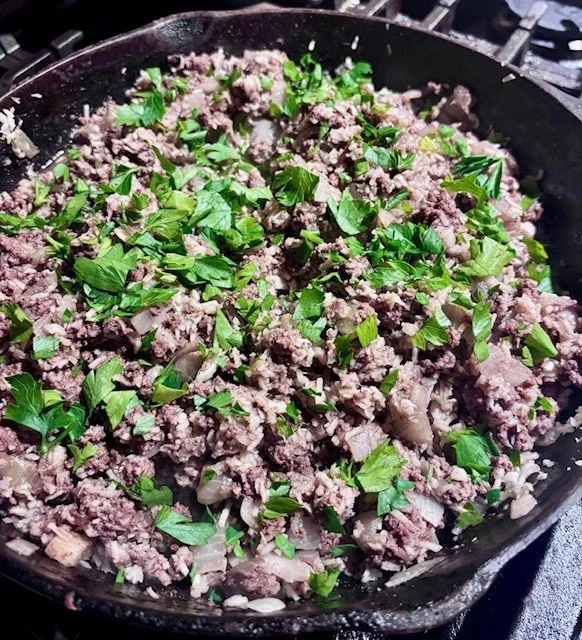
The finished dish was hearty, aromatic, and filling, with fresh parsley adding a beautiful splash of color.
So, how did it taste?
Well, we’ll get to that in a minute! 😉
🇱🇧 Lebanese-Inspired Hashweh with Hearts of Palm Rice
A quick, lower-carb adaptation of a traditional Lebanese ground beef and rice dish.
Prep Time: Approximately 10 minutes
Cook Time: Approximately 20 minutes
Total Time: Approximately 30 minutes
Servings: 6
Equipment: Large 12-inch skillet
Ingredients
Beef and Vegetables
2 lbs ground beef (85/15 preferred)
1 large onion, finely diced
4 cloves garlic, minced (or 2 tsp garlic powder)
2 packages (9 oz each) Natural Heaven Hearts of Palm Rice
2 Tbsp salted butter
1 Tbsp olive oil, if needed
Spices
1½ tsp salt, plus additional to taste
½ tsp black pepper
1½ tsp ground allspice
1 tsp ground cinnamon
1 tsp ground cumin
½ tsp ground coriander
¼ tsp ground nutmeg
¼ tsp ground cardamom (optional)
Liquid and Finishing
¼ cup chicken broth
¼ cup fresh parsley, chopped
Instructions
1. Brown the ground beef and onions.
In a large 12-inch skillet over medium heat, combine the ground beef and diced onion.
Cook approximately 10–12 minutes, breaking the beef into small pieces as it browns.
Continue cooking until the beef is fully browned and the onions have softened.
Drain excess grease if necessary.
If you’re using particularly lean ground beef, add a little olive oil as needed.
2. Add the garlic and spices.
Stir in the minced garlic or garlic powder, salt, black pepper, allspice, cinnamon, cumin, coriander, nutmeg, and optional cardamom.
Cook for approximately 1 minute, stirring frequently, until the spices become fragrant and evenly coat the beef.
3. Prepare the hearts of palm rice.
Drain both packages of Natural Heaven Hearts of Palm Rice.
Rinse briefly under cool water and allow the rice to drain thoroughly.
Unlike traditional rice, hearts of palm rice doesn’t absorb liquid or expand during cooking. That’s why this recipe requires only a small amount of broth.
4. Combine everything.
Add the drained hearts of palm rice to the skillet.
Stir in the salted butter and ¼ cup chicken broth.
Mix thoroughly, distributing the seasoned beef and onions evenly throughout the rice.
5. Simmer.
Reduce the heat to medium-low.
Cook uncovered for approximately 5–8 minutes, stirring occasionally, until the hearts of palm rice is heated through and the flavors have blended.
If the mixture seems too dry, add another tablespoon or two of broth.
If there’s excess liquid, allow it to evaporate.
The finished dish should be moist but not soupy.
6. Finish with parsley.
Stir in the freshly chopped parsley.
Taste and adjust the seasonings as needed.
I found that mine needed a little additional salt to bring out the flavors.
Serve hot!
🌿 A Few Notes from My Kitchen
About the rice: Traditional Lebanese Hashweh uses regular rice, which absorbs the seasoned cooking liquid and develops a different texture. My hearts of palm substitution keeps the carbohydrates much lower, but it does change the finished dish.
About the spices: Allspice is particularly important to the flavor of Hashweh. Combined with cinnamon, cumin, coriander, and nutmeg, it creates a warm, aromatic seasoning without making the dish spicy-hot.
About the broth: Don’t add the amount of broth you’d normally use when cooking rice! Hearts of palm rice doesn’t absorb liquid the same way, and too much broth will leave the dish watery.
About the parsley: Fresh parsley adds color and a little freshness to the finished dish. I wouldn’t skip it!
About the salt: I started with 1½ teaspoons but added a little more after tasting. Adjust according to your preferences.
About the mushrooms: There aren’t any mushrooms in this recipe, but you know how much I love them! If I make this again, I’m seriously considering adding some sautéed mushrooms for extra flavor and texture.
What Should You Serve with Hashweh?
One thing I discovered after preparing this dish is that Hashweh is often enjoyed as part of a larger Lebanese meal.
It can accompany roasted chicken or other meats, and it’s frequently served with fresh salads, yogurt-based dishes, or vegetables.
Some traditional accompaniments include:
Laban bi Khyar: A cooling yogurt and cucumber salad seasoned with garlic and mint.
Fattoush: A fresh Lebanese salad with vegetables, herbs, and toasted pita bread.
Roasted vegetables: Cauliflower and other roasted vegetables make a delicious accompaniment.
Grilled or roasted chicken: A wonderful way to turn Hashweh into part of a larger meal.
For my low-carb version, I think roasted cauliflower or zucchini would be especially good.
And honestly, I suspect that adding a few complementary side dishes would make this meal much more interesting!
❤️ The Verdict from My Kitchen
Well, here’s where I’m going to be completely candid.
This one was good. But it wasn’t a WOW!
The flavor was actually quite nice. I enjoyed the combination of warm spices, and after adding a little extra salt, the seasoning was just right.
There wasn’t anything wrong with the dish.
It just felt like something was missing.
Unlike some of my other international cooking adventures, where I took one bite and immediately knew I’d be making the recipe again, this one left me thinking, “Well, that’s good.”
And that’s okay!
After learning more about how Hashweh is traditionally served, I suspect part of the problem was that I prepared it as a complete meal rather than as part of a larger spread.
A few well-chosen side dishes might have made all the difference.
I also recognize that my substitution of hearts of palm rice for traditional rice changed the texture and probably the overall experience.
Someone preparing this with regular rice and serving it alongside traditional Lebanese accompaniments might absolutely love it!
Would I make it again?
Possibly!
It’s quick, easy, filling, and relatively low in carbohydrates. On a busy day when I want something homemade without spending much time in the kitchen, I can certainly see its appeal.
And if I do make it again, there’s a very good chance I’ll be throwing in some mushrooms! 🍄
But here’s something I’ve learned through these international cooking adventures:
Not every recipe has to become a new favorite.
Sometimes the experience is simply about trying something different, learning a little about another country’s food traditions, and discovering what you do—or don’t—particularly enjoy.
And that’s part of the fun!
So, Lebanon, thank you for introducing me to Hashweh. 🇱🇧
It may not have earned a five-star review from my kitchen, but it certainly earned its place in my international cooking collection.
And who knows? Perhaps someone reading this will prepare it with traditional rice, add a few delicious side dishes, and discover a new family favorite!
That’s what sharing recipes is all about.
From the Kitchen. From the Farm. From the Heart. ❤️